
When the days of Navaratri arrive, something changes in South Indian homes. The furniture gets rearranged. The wooden steps come out of storage. The dolls that have been carefully wrapped and kept through the year finally see light again. Lamps are lit every evening. The smell of incense fills the rooms. Neighbours knock on the door and come in to admire what has been put together with weeks of thought and years of collecting.
This is Golu. And if you have grown up with this tradition, no further explanation is needed. If you are discovering it for the first time or rediscovering it after years away, welcome to one of the most beautiful and genuinely alive traditions in all of South Indian culture.
This Navaratri 2026 begins on 22nd September. If you are planning your Golu display, this guide covers everything you need to know — from the meaning behind every step to the rituals that make these nine nights so special.
What Is Navaratri Golu?
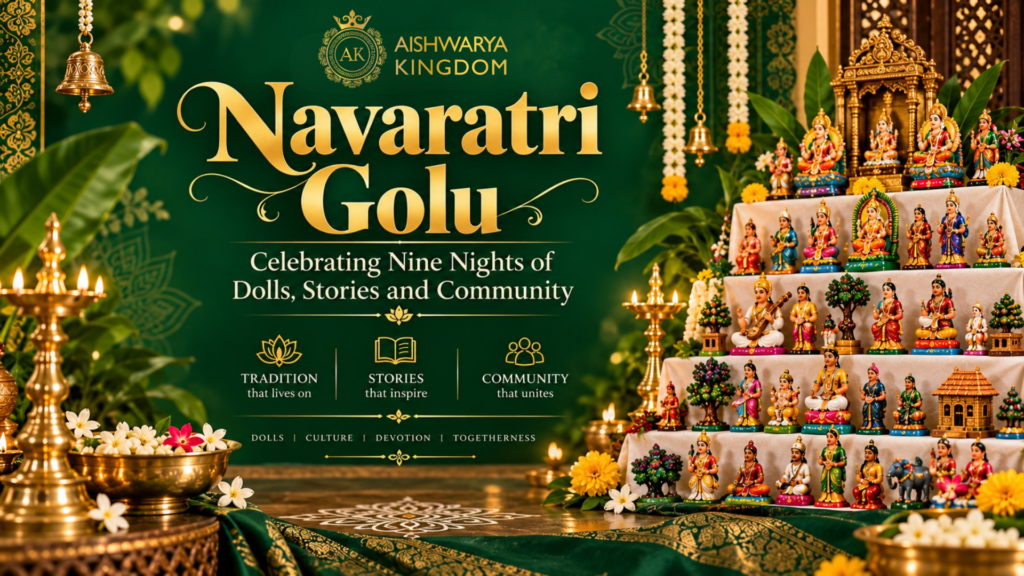
Golu is a spectacular tiered arrangement of dolls, idols and figurines displayed in South Indian homes during the nine days of Navaratri. The display is built on odd-numbered steps — 3, 5, 7, 9 or 11 — with the sacred and divine at the top and scenes of everyday life at the bottom.
In Tamil it is called Bommai Golu or simply Kolu. In Telugu it is known as Bommala Koluvu. The names vary across states but the tradition is the same — a carefully arranged display that tells the stories of Indian culture, mythology, devotion and daily life in miniature form.
The Golu represents the assembly of Goddess Durga before her great battle with the demon Mahishasura. It symbolises the victory of good over evil — the central theme of the entire Navaratri festival. But it is more than just symbolism. It is also a social tradition, a creative expression, a family project and a community celebration all at once.
Just as the Golu tells a story through its dolls and arrangement, the handcrafted Dasavatharam Vertical Panel from AK Crafts narrates one of the greatest sacred stories in all of Indian tradition — the tale of Lord Vishnu’s ten divine avatars — in a single beautifully carved wooden panel that brings extraordinary depth and sacred meaning to any Golu display it joins.
The Story Behind the Nine Nights
The word Navaratri literally means nine nights in Sanskrit — Nava meaning nine and Ratri meaning night. But these are not just nine nights of festivity. Each set of three nights honours a specific manifestation of the divine feminine.
First 3 Nights — Goddess Durga
Courage, strength and protection
Next 3 Nights — Goddess Lakshmi
Abundance, wealth and prosperity
Last 3 Nights — Goddess Saraswati
Wisdom, learning and creativity
The progression from Durga to Lakshmi to Saraswati tells a complete story. First the obstacles are removed through courage and strength. Then abundance and prosperity follow. Finally wisdom and knowledge crown the celebration. The tenth day — Vijayadasami — marks the victory that all nine nights have been building toward.
For South Indian families, these nine nights mean evening poojas, visits to neighbours to see their Golu displays, the giving and receiving of Thamboolam and the daily preparation of sundal — the traditional prasadam that becomes the taste of Navaratri for everyone who grew up with this festival.
The Meaning Behind the Steps
The steps of the Golu are not random. Each level carries specific meaning and specific types of figures that belong there. Understanding this helps you arrange your Golu in the way that honours the tradition most completely.
Top Steps
Gods and Goddesses — Durga, Lakshmi, Saraswati, Ganesha, Vishnu
Divinity and the highest spiritual goals
Middle Steps
Saints, sages, kings, mythological characters from Ramayana and Mahabharata
Wisdom, leadership and cultural heritage
Lower Steps
Scenes of everyday life — farmers, markets, children playing, wedding scenes
Connection to earthly life, community and nature
The top tiers carry the divine. The middle steps carry the wisdom figures who bridge the divine and the human. The lower steps capture the beautiful ordinariness of life — a farmer ploughing his field, children at play, a market scene with vendors and buyers, a wedding ceremony with all its colour and community.
Together these steps tell the complete story of existence — from the divine at the top all the way down to everyday life at the bottom, with every layer connected to and dependent on every other.
The Dasavatharam Vertical Panel from AK Crafts belongs beautifully on the top or upper middle steps of this arrangement. Depicting all ten divine avatars of Lord Vishnu in a single handcrafted wooden panel with traditional temple beeding, it brings the complete sacred narrative of the Dashavatara tradition to the most honoured position in your Golu display.
The Heart of Golu – Marapachi Dolls
No Golu is complete without the Marapachi dolls. If you have grown up in a Tamil household, you know exactly what these are. If this is your first Navaratri Golu, the Marapachi dolls are the traditional wooden bride and groom figures that occupy a place of special honour in the Golu display.
Marapachi dolls are typically made from neem, sandalwood or rosewood — sacred woods that carry their own significance in South Indian tradition. They are traditionally gifted to a daughter at the time of her marriage and represent fertility, family continuity and the bonds between generations.
Many families have Marapachi dolls that are decades old — passed down from grandmothers to mothers to daughters with the accumulated memories of every Navaratri they have been part of. Bringing these dolls out every year and placing them in their honoured position in the Golu is one of the most emotionally resonant parts of the entire festival for many South Indian families.
Like the cherished Marapachi dolls, the Dasavatharam Vertical Panel from AK Crafts is handcrafted from quality natural wood by skilled artisans in Chennai, made with the intention of becoming a family heirloom that is displayed every year with the same care and affection that families bring to their most treasured Golu pieces.
Types of Golu Dolls and Themes
One of the most wonderful things about the Golu tradition is how much creative freedom it offers. Within the broad structure of deity figures at the top and everyday life at the bottom, there is enormous scope for personal expression, thematic storytelling and contemporary creativity.
Traditional Golu Dolls:
- Clay and terracotta dolls of deities
- Mythological characters from Ramayana and Mahabharata
- Marapachi wooden couple
- Chettiar shopkeeper doll with groceries
- Sacred animals — cows, elephants, horses
Modern Golu Themes:
- Themes on environmental conservation
- Miniature trains, beaches and travel scenes
- Freedom fighters and national heroes
- Modern city scenes and professional figures
- Women empowerment and social awareness themes
Every Golu is unique to the family that creates it. Some families are known for extraordinarily elaborate displays with hundreds of dolls accumulated over generations. Others keep their arrangement small and intimate, with a few carefully chosen pieces that carry deep personal meaning.
The themes change from year to year as families add new pieces that reflect contemporary concerns alongside traditional devotion. Seeing a neighbour’s Golu and noticing new additions, new themes and new arrangements is one of the genuine pleasures of the Navaratri visiting tradition.
The Rituals and Social Traditions of Navaratri Golu
The daily rituals of Navaratri Golu are what make these nine days feel different from every other time of year. The house carries a different energy. The mornings and evenings follow a sacred rhythm. The social dimension of the festival brings the community together in a way that few other celebrations do.
Daily Practices:
Every morning the Golu space is cleaned and fresh kolam is drawn in front of the steps. Lamps are lit in the morning and evening. Pooja is performed with the singing or chanting of appropriate slokas. Neivedhyam — food offerings — are prepared and placed before the divine figures on the top steps before the family partakes.
The Social Dimension:
Families invite neighbours, relatives, friends and colleagues to visit their Golu display during the nine days. These visits are not just social calls. They are a genuine sharing of devotion and creative expression. Visitors admire the arrangement, ask about specific pieces, share memories of their own Golu experiences and take genuine delight in what has been put together.
When guests arrive, hosts offer Thamboolam — the traditional gift that typically includes betel leaves, kumkum, turmeric, a small fruit and often a gift. The Thamboolam is part of how the festival builds and maintains community bonds across nine nights of mutual visiting and celebration.
The Prasadam:
The ritual food of Navaratri Golu is sundal — a protein-rich snack made from a different legume each day, tempered with mustard seeds, curry leaves, coconut and red chillies. Each family typically makes a different variety of sundal each day of the festival, and the sundal served at different homes during Golu visits becomes one of the most talked-about aspects of the social celebrations.
Beyond sundal, families also prepare payasam, laddoo, kesari and other festive sweets that are shared with visitors and offered as neivedhyam throughout the nine days.
Why Handcrafted Wooden Decor Is Perfect for Your Golu Display
There is a difference between a Golu display that is assembled from whatever is available and one that has been built thoughtfully with pieces that carry genuine craft quality and sacred meaning. The latter is the kind of Golu that visitors remember. It is the kind that photographs beautifully. It is the kind that becomes a reference point for the family’s Navaratri tradition across many years.
Handcrafted wooden pieces belong in a Golu display in a way that mass-produced plastic and resin alternatives simply do not. The natural warmth of quality wood, the character of genuine hand carving and the cultural authenticity of pieces made within South Indian craft traditions all contribute to a Golu display that feels genuinely sacred rather than merely festive.
The Dasavatharam Vertical Panel From AK Crafts:
The Dasavatharam Vertical Panel from AK Crafts is the handcrafted wooden piece that elevates any Golu display it joins to an entirely different level.
This beautifully carved panel depicts all ten divine avatars of Lord Vishnu — the complete Dashavatara narrative from Matsya the fish who saved the sacred Vedas to Kalki the future avatar yet to come — on a single vertical wooden panel with traditional temple beeding.
🐟 Matsya — Saved the sacred Vedas from the cosmic flood
🐢 Kurma — Supported Mount Mandara during Samudra Manthan
🐗 Varaha — Rescued the earth from demon Hiranyaksha
🦁 Narasimha — Protected the devoted Prahlada
👶 Vamana — Reclaimed the three worlds from King Bali
🪓 Parashurama — Restored justice across the earth
👑 Rama — The ideal king who upheld dharma
🪈 Krishna — The divine cowherd who delivered the Bhagavad Gita
🧘 Buddha — The enlightened one who taught compassion
🐴 Kalki — The future avatar yet to come
Every avatar is carved with genuine iconographic accuracy by skilled South Indian artisans in Chennai who have spent years developing their craft within the woodcarving traditions of this region. This is not a mass-produced piece. Every panel is made entirely by hand from quality natural wood with real devotional understanding behind every carved detail.
Available in Polished 3 FT, Polished 4 FT, Painted 3 FT and Painted 4 FT — giving every family the flexibility to choose the scale and finish that best suits their Golu display and their home.
The panel carries heirloom value. Like the best Marapachi dolls and the finest traditional Golu pieces, it is made to be displayed year after year and passed down through the family as a treasured part of the Navaratri tradition.
👉 Explore the Dasavatharam Vertical Panel: https://akcrafts.shop/product/wooden-handcrafted-dasavatharam-vertical-panel-with-temple-beeding-painted/
Frequently Asked Questions About Navaratri Golu
What is Golu in Navaratri?
Golu is a spectacular tiered arrangement of dolls displayed on odd-numbered steps during the nine days of Navaratri in South Indian homes. It represents the assembly of Goddess Durga before her battle with Mahishasura and symbolises the victory of good over evil. Also called Bommai Golu in Tamil and Bommala Koluvu in Telugu.
What is the significance of Golu dolls?
The dolls in a Golu display represent the hierarchy of the universe — divinity at the top, earthly life at the bottom. Together they tell the story of Indian culture, mythology and daily life while symbolising the complete order of creation from the divine to the ordinary.
How many steps are used for a Golu display?
Odd-numbered steps are traditional — 3, 5, 7, 9 or 11. Nine steps are considered especially auspicious as they represent the nine nights of Navaratri. Most families use whichever odd number suits their available space.
What is the most important Golu doll?
The Marapachi dolls — a traditional wooden couple typically made from neem, sandalwood or rosewood — hold a place of special honour in the Golu tradition. They are often family heirlooms gifted at the time of marriage and represent fertility, family continuity and the bonds between generations.
What food is offered during Golu?
Sundal — a protein-rich snack made from legumes tempered with coconut and curry leaves — is the signature prasadam of Navaratri Golu. Different legumes are used each day. Payasam, laddoo and kesari are also commonly prepared and shared during the festival.
When does Navaratri 2026 begin?
Navaratri 2026 begins on 22nd September 2026 and runs through to 1st October 2026. Vijayadasami falls on 2nd October 2026.
Can handcrafted wooden pieces be added to a traditional Golu?
Absolutely. Handcrafted wooden pieces are among the most traditionally appropriate additions to any Golu display. Quality wooden figures made by skilled artisans carry the natural warmth, cultural authenticity and craft character that belong in a Golu tradition built around genuine South Indian sacred art.
After nine hectic evenings of hosting, visiting, fasting and feasting, when the Golu arrangement is finally dismantled on Vijayadasami, there is always an unmistakable feeling of both completion and loss. The house returns to normal. The steps go back into storage. The dolls are carefully wrapped and put away until next year.
But the memories stay. The conversations with neighbours who admired a particular piece. The children who asked questions about the mythological figures. The photographs that captured the display at its most beautiful in the lamplight of one of the nine evenings.
The best Golu displays are built over years — piece by piece, festival by festival — with each new addition chosen carefully for its quality, its meaning and its contribution to the overall story the display tells.
This Navaratri 2026, makes your Golu truly memorable. Add a piece that carries genuine South Indian craft tradition and sacred meaning to your display. The Dasavatharam Vertical Panel from AK Crafts is exactly that kind of piece.
👉 Explore the Dasavatharam Vertical Panel:
https://akcrafts.shop/product/wooden-handcrafted-dasavatharam-vertical-panel-with-temple-beeding-painted/
👉 Browse the Full AK Crafts Collection:
https://akcrafts.shop/