
There is something about Vinayagar Chathurthi that feels different from every other festival in the Indian calendar. The energy in the streets changes. Homes fill with the smell of fresh flowers and incense. The sound of devotional songs comes from every direction. Children help arrange the pooja space. Families who have not seen each other in months come together around a freshly installed Ganesha idol and the festival begins.
Vinayagar Chathurthi 2026 falls on Sunday, September 14. If you are planning your celebration, this guide covers everything — the history behind the festival, the traditions that make it so meaningful, a simple step-by-step home pooja guide, the prasadams that define the celebration and how to choose the right Ganesha idol for your home.
What Is Vinayagar Chathurthi?
Vinayagar Chathurthi — also known as Ganesh Chaturthi across India — is the festival that celebrates the birth of Lord Ganesha, the beloved elephant-headed deity who is the son of Lord Shiva and Goddess Parvati and who holds the most important position in Hindu tradition as the remover of obstacles and the god of new beginnings.
The name comes from two Sanskrit words — Ganesha meaning lord of all beings and Chaturthi meaning the fourth day, as the festival is celebrated on the fourth day of the bright fortnight of the Hindu month of Bhadrapada.
In Tamil Nadu the festival is known as Vinayagar Chathurthi — Vinayagar being one of Lord Ganesha’s most beloved Tamil names, meaning the one who leads without obstacles. The festival is celebrated with particular devotion across Tamil Nadu, where Ganesha holds a central place in both home and temple devotional life throughout the year.
The Story Behind Vinayagar Chathurthi
The most widely told story behind Vinayagar Chathurthi involves the creation of Lord Ganesha himself.
According to the Shiva Purana, Goddess Parvati created Ganesha from sandalwood paste while bathing, bringing him to life and asking him to guard the entrance to her chambers. When Lord Shiva returned and was denied entry by the boy, a fierce battle followed that ended with Shiva severing the boy’s head.
When Parvati returned and saw what had happened, her grief was so profound that Shiva sent his attendants to bring back the head of the first creature they found sleeping with its head facing north. They found an elephant and returned with its head, which Shiva placed on the boy’s body and brought him back to life as his own son, blessing him with the most elevated position among the gods.
This is why Lord Ganesha is depicted with an elephant head — and why he is invoked before every auspicious beginning, every important undertaking and every devotional practice. He is the first among all gods to be honoured because his father, the supreme Shiva himself, placed him there.
Why Every Occasion Begins With Ganesha
You may have noticed that almost every Hindu ritual, every pooja, every wedding, every housewarming, every new business beginning and every auspicious occasion starts with a prayer to Lord Ganesha. This is not coincidence or mere tradition — it reflects a deep theological conviction about the nature of obstacles and beginnings.
Lord Ganesha as Vigneshwara is the lord of obstacles — he can both create and remove them. Beginning any important activity without first seeking his blessing is considered inauspicious because without his grace, unexpected obstacles can arise and derail even the most carefully planned efforts.
Vinayagar Chathurthi is the festival that honours this most beloved of deities on his birth anniversary with the full devotion, joy and community celebration that Lord Ganesha deserves from the families and communities who have loved him and sought his blessings across centuries of continuous South Indian devotional life.
How Vinayagar Chathurthi Is Celebrated
The celebration of Vinayagar Chathurthi varies from the grand public — with enormous community pandals, processions and immersions — to the intimately personal, with families setting up a beautifully arranged home pooja space and celebrating the festival within the warmth of their own sacred home environment.
Community Celebrations:
In cities across Tamil Nadu, large Ganesha idols are installed in community pandals that become gathering places for entire neighbourhoods during the festival. Devotional music plays continuously. Priests perform elaborate rituals. Devotees queue for hours to have darshan of the beautifully decorated community Ganesha. The energy is festive, devotional and deeply communal.
Home Celebrations:
At home, families install a Ganesha idol in their pooja room or in a specially prepared space, perform the Shodashopachara pooja — the sixteen-step worship ritual — and maintain the idol’s presence in the home for one and a half days or in some traditions for three, five, seven or eleven days before the visarjan immersion.
The home celebration is in many ways the more intimate and personally meaningful version of the festival. The Ganesha idol that sits in your pooja room during these days is your family’s own divine guest — honoured, cared for and celebrated with the specific devotional character of your household.
Step-by-Step Home Pooja Guide for Vinayagar Chathurthi 2026
If you are setting up your home Vinayagar Chathurthi pooja for the first time or want to ensure your celebration follows the traditional approach, here is a simple and complete guide.
What You Will Need:
Fresh flowers — preferably red and yellow
Durva grass — the sacred grass specifically associated with Ganesha
Modakam and Kozhukattai — the traditional prasadams
Fresh fruits
Coconut
Camphor and incense
A diya with ghee or oil
Turmeric and kumkum
Sandalwood paste
A clean cloth for the idol’s placement
The Ganesha idol
The Day Before — Preparation:
Clean the pooja space thoroughly and decorate it with fresh flowers and kolam. Prepare the cloth placement for the idol. Gather all the required pooja materials. Prepare the modakam and kozhukattai for offering.
On the Day — Morning Pooja:
Wake early and bathe before beginning the pooja. Set up the Ganesha idol on the prepared cloth in the pooja space. Light the diya and incense.
Begin with the Ganapati Prarthana — the invocation prayer that invites Lord Ganesha’s divine presence into the idol installed in your home.
Apply turmeric and kumkum. Offer sandalwood paste. Offer fresh flowers, placing them at the feet of the idol. Offer durva grass — Ganesha is particularly pleased by durva grass offerings. Offer coconut. Offer the modakam and kozhukattai. Light camphor and perform the aarti while chanting or listening to Ganesha slokas.
During the Festival Days:
Perform morning and evening poojas. Keep fresh flowers and a lit diya in the pooja space throughout the festival days. Family members can offer individual prayers throughout the day. Play or listen to devotional music dedicated to Lord Ganesha.
The Prasadams of Vinayagar Chathurthi
No Vinayagar Chathurthi celebration is complete without the prasadams that have become as much a part of this festival’s identity as the Ganesha idol itself.
Kozhukattai:
Kozhukattai is the traditional South Indian steamed rice dumpling that is the signature prasadam of Vinayagar Chathurthi in Tamil Nadu. Made from rice flour dough filled with sweet coconut and jaggery or savoury options, these small dumplings are steamed and offered to Lord Ganesha before being shared among family members and guests.
The connection between kozhukattai and Vinayagar Chathurthi is so strong in Tamil culture that the festival is almost synonymous with the sweet. Making kozhukattai at home — with family members participating in the shaping and filling — is one of the most beloved domestic traditions of this festival.
Modakam:
Modakam — also known as modak in North India — is considered Lord Ganesha’s favourite sweet. The steamed or fried dumpling filled with coconut and jaggery carries deep symbolic meaning — its sweetness represents the sweetness of spiritual knowledge and the outer shell represents the material world that holds this inner sweetness.
Offering modakam to Lord Ganesha during Vinayagar Chathurthi is one of the most important acts of devotional worship during the festival.
Panchamrit:
The five-ingredient sacred mixture of milk, curd, honey, ghee and sugar used to bathe the Ganesha idol during the abhishekam ritual. Each ingredient carries its own sacred symbolism and the combined offering is deeply auspicious in Hindu ritual worship.
Other Traditional Offerings:
Sundal made from white chickpeas or other legumes. Fresh fruits particularly bananas which Ganesha is said to love. Coconut in various forms. Sweet pongal prepared with jaggery and ghee.
Choosing the Right Ganesha Idol for Your Home
The Ganesha idol you choose for your Vinayagar Chathurthi celebration is the most important element of your home festival. It is the sacred presence around which every ritual, every prayer and every family gathering during these festival days is arranged.
There are several options available and understanding what each offers helps you make a choice that genuinely suits your home, your devotional practice and your values.
Clay Ganesha Idols:
Traditional clay idols are the most environmentally significant choice for Vinayagar Chathurthi because they dissolve completely during the visarjan immersion without harming water bodies or aquatic life. Natural clay Ganesha idols painted with natural colours are the most eco-friendly option available and have become increasingly popular among families who are conscious of the environmental impact of their celebrations.
Brass Ganesha Idols:
Brass Ganesha idols are permanent sacred art pieces rather than festival-specific items. A quality brass Ganesha idol is installed in the home pooja room permanently and remains there year-round as a daily devotional presence. During Vinayagar Chathurthi, the existing brass Ganesha in the pooja room becomes the centrepiece of the festival worship rather than being replaced by a temporary idol.
The natural warmth of quality brass, the way it catches light during diya and lamp illumination and the cultural heritage of brass craft in South Indian sacred art make a genuine brass Ganesha idol one of the most beautiful and lasting sacred art investments a family can make for their pooja room.
Wooden Ganesha Idols:
Handcrafted wooden Ganesha idols from skilled South Indian artisans carry a sacred character that is completely unique to this material and craft tradition. Quality natural wood carved by craftsmen who understand the iconographic requirements of Lord Ganesha’s divine form produces pieces that are both artistically extraordinary and devotionally meaningful.
A wooden Ganesha idol from a genuine craft source is a permanent sacred art piece of the highest quality — one that develops a richer character the longer it is owned and displayed, that carries the cultural heritage of South Indian woodcarving tradition in every carved detail and that becomes a treasured part of the family’s devotional life that can be passed down through generations.
AK Crafts Ganesha Collection:
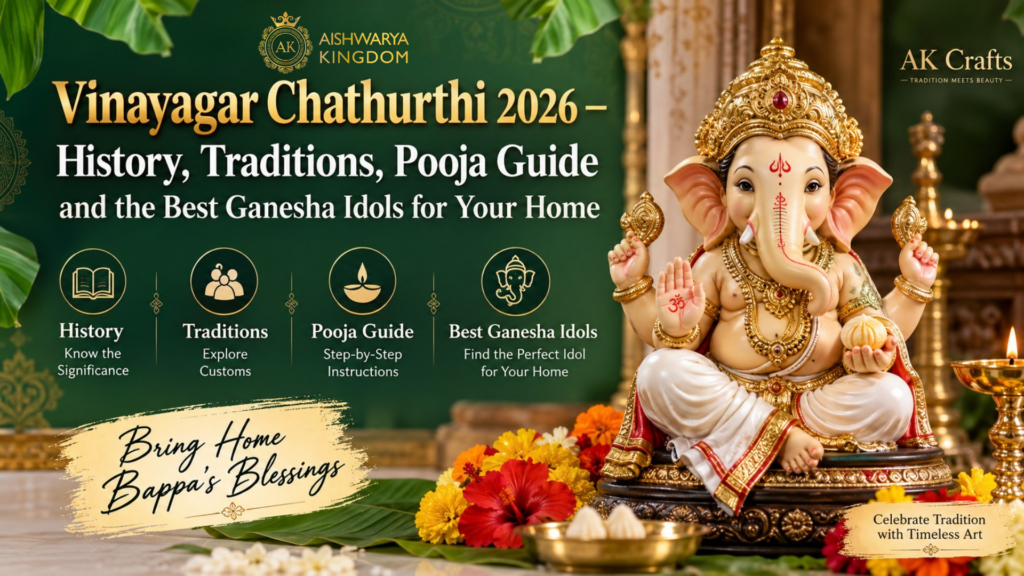
AK Crafts offers handcrafted Ganesha idols made from quality natural wood and brass by skilled South Indian artisans in Chennai who understand both the iconographic tradition of Lord Ganesha’s sacred form and the craft techniques needed to render it with genuine accuracy and devotional care.
Every Ganesha idol from AK Crafts is made entirely by hand. The iconographic details — the elephant head, the broken tusk, the modakam in hand, the mouse at the feet — are rendered with the accuracy that comes from real craft knowledge rather than mass production approximation.
This Vinayagar Chathurthi 2026, bringing a genuinely handcrafted Ganesha idol from AK Crafts into your home celebration is one of the most meaningful ways to honour Lord Ganesha with the quality and devotional authenticity that he deserves.
👉 Explore the AK Crafts Ganesha Collection: https://akcrafts.shop/
Eco-Friendly Celebrations – Why It Matters
In recent years there has been a growing and genuinely important movement toward more environmentally conscious Vinayagar Chathurthi celebrations. The large-scale immersion of plaster of Paris Ganesha idols painted with chemical colours has caused documented damage to water bodies and aquatic ecosystems across India.
Making more conscious choices about your celebration — choosing natural clay idols for festival-specific installations, opting for permanent brass or wooden Ganesha idols that do not require immersion, using natural flowers and organic materials in your decoration and keeping celebrations intimate and home-centred — are all ways that devotees can honour Lord Ganesha with genuine care for the environment he watches over.
The shift toward permanent handcrafted Ganesha idols in brass and wood for home pooja rooms, combined with beautiful clay installations for the festival days that dissolve harmlessly in water, is one of the most balanced and meaningful approaches to Vinayagar Chathurthi celebration available to Indian families today.
Vinayagar Chathurthi Wishes and Greetings 2026
This Vinayagar Chathurthi 2026, may Lord Ganesha remove every obstacle from your path, bless every new beginning you undertake and fill your home and family with the prosperity, wisdom and grace that his divine presence always brings.
Vinayagar Chathurthi Vazhthukkal to you and your entire family. May this September 14 be the beginning of a wonderful new chapter filled with Ganesha’s boundless blessings.
Frequently Asked Questions About Vinayagar Chathurthi
When is Vinayagar Chathurthi 2026?
Vinayagar Chathurthi 2026 falls on Sunday, September 14, 2026.
Why is Ganesha worshipped first before all other gods?
Lord Ganesha as Vigneshwara is the lord and remover of obstacles. Lord Shiva himself placed Ganesha in the most elevated position among all deities, making him the first to be honoured before any auspicious beginning or important undertaking.
What is the most important prasadam for Vinayagar Chathurthi?
Kozhukattai and Modakam are the most important prasadams. Modakam is considered Lord Ganesha’s favourite sweet and kozhukattai is the traditional South Indian festival prasadam most closely associated with Vinayagar Chathurthi in Tamil culture.
What is durva grass and why is it important for Vinayagar Chathurthi?
Durva grass is a sacred grass that Lord Ganesha is particularly pleased by as an offering. Offering durva grass during Vinayagar Chathurthi pooja is considered one of the most auspicious acts of worship and is an essential part of the traditional pooja ritual.
How many days is Vinayagar Chathurthi celebrated?
The duration varies by tradition. Some families celebrate for one and a half days, others for three, five, seven or eleven days before the visarjan. The most common home celebration duration is one and a half days.
What is the eco-friendly way to celebrate Vinayagar Chathurthi?
Choosing natural clay Ganesha idols painted with natural colours for the festival installation, using organic flowers and natural materials for decoration and opting for home immersion in a bucket of water rather than large water body immersion are all eco-friendly approaches to celebrating Vinayagar Chathurthi with genuine environmental consciousness.
Can I use a permanent Ganesha idol for Vinayagar Chathurthi?
Yes. Many families celebrate Vinayagar Chathurthi by performing the full pooja rituals with their permanent brass or wooden Ganesha idol in the home pooja room rather than installing a temporary idol. This is a completely valid and increasingly popular approach that combines devotional authenticity with environmental consciousness.
Vinayagar Chathurthi is one of those festivals that reminds every family why these traditions matter. The preparation, the rituals, the prasadams, the family gathering, the devotional atmosphere in the home — all of it creates memories that stay with everyone who experiences it, from the eldest family member who remembers decades of celebrations to the youngest child who is experiencing it for the first time.
This Vinayagar Chathurthi 2026 on September 14, celebrates Lord Ganesha with the full devotion, genuine ritual care and cultural authenticity that this festival and this beloved deity deserve.
And if you are looking for a Ganesha idol that carries real craft quality and genuine South Indian artisan tradition into your home celebration and your pooja room permanently, AK Crafts is where that search ends.
👉 Explore the AK Crafts Collection: https://akcrafts.shop/
Vinayagar Chathurthi Vazhthukkal! 🙏